
Fashion and engineering collide to rethink how humans and robots share space
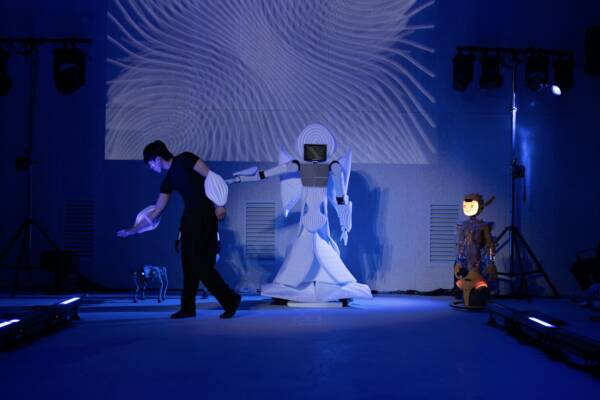
Robots stepped onto the runway at Humanoids’25, not as lab tools or industrial machines, but as performers. They walked, spun, and danced alongside humans in a fashion show that used design to question how robots should look, feel, and behave once they enter everyday human environments.
Held at the 2025 IEEE-RAS International Conference on Humanoid Robots and co-hosted by the University of Seoul Startup Support Foundation, the robot fashion show challenged the usual cold, mechanical image of robotics. The focus was not aesthetics alone. It was safety, coexistence, and how creative design can make robots more natural to interact with.
Where robotics meets culture
The show was creatively directed by Jean Oh, associate research professor at Carnegie Mellon University’s Robotics Institute, and Jie-Eun Hwang, professor of architecture at the University of Seoul. Their goal was simple but ambitious: bring roboticists, artists, designers, and musicians into the same space and let them build together.
The central idea was that a shared, soft layer between humans and robots could reduce fear and friction. Clothing became more than decoration. It acted as protection, interface, and communication.
Oh emphasized that as robots become more visible in public life, researchers need better ways to explain and explore their impact.
“In the future, robots will need to perform contact-rich tasks while staying safe through both physical and social compliance,” she explained. “Fashion gives us a way to explore safe motion, softness, and wearable robotics in ways engineering alone often doesn’t.”
Designers building safer robots
Participants were selected through peer review and invitation, with an emphasis on originality and perspective. Many of them were both researchers and artists who designed their own robotic systems.
One of the standout contributors was Hyun Woo Park, also known as Hyun Parke, a research associate at CMU’s Robotics Institute and the show’s art director. His work focuses on inflatable robotics designed to make machines less intimidating.
For the runway, Parke created an air-filled vest and skirt that wrapped around a humanoid robot’s rigid body. The garment softened impacts and allowed for safe physical contact.
“If robots are going to build close relationships with people, the first requirement is physical safety,” Parke said. “I wanted to design something that could allow a hug.”
During the performance, human performers embraced the robot, turning a typically rigid machine into something approachable and almost emotional.
Rethinking touch and material
Designer Junhee Cho addressed another barrier to human-robot interaction: touch. Motors, vibrations, and cold metal often make robots feel distant and uncomfortable.
To counter this, Cho used melamine foam, a lightweight and insulating material, shaping it into flowing, architectural forms with the help of an industrial robotic arm. Draped over a humanoid robot, the foam created a visual and physical contrast that transformed the machine’s presence.
“Those awkward sensations create distance,” Cho said. “This project asks how we should welcome robots into society and how we can share space and happiness with them.”
A vision of coexistence
The show took place at the Seoul Impact Arena at the University of Seoul. Each designer presented a distinct vision of coexistence. Some featured inflatable garments that cushioned motion. Others introduced protective shells designed for elder care robots. Several focused on expressive silhouettes that balanced function with storytelling.
Every performance was paired with a custom audio track, turning the runway into a shared experiment in movement, sound, and interaction.
Rather than presenting robots as tools, the event framed them as future partners in human spaces. It raised a critical question: if robots are going to live and work among us, how should they move, feel, and connect?
The robot fashion show offered no single answer, but it made one thing clear. Designing the future of robotics is not just an engineering problem. It is also a cultural one.
Vraj Parikh