
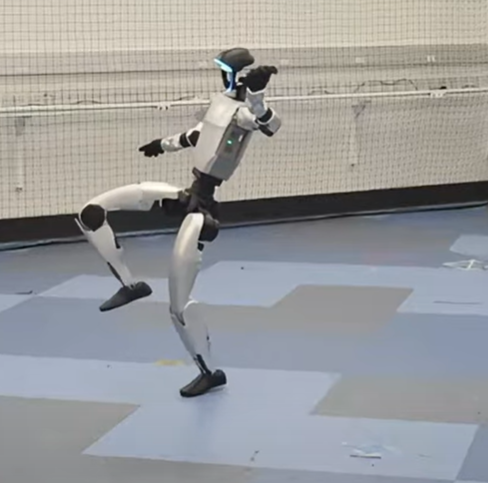
Researchers at Carnegie Mellon University (CMU) and Meta have developed a new humanoid robot control system called BFM-Zero, designed to help robots adapt smoothly to many different tasks without needing retraining for each one.
With BFM-Zero, humanoid robots can walk, run, recover from falls, absorb impacts, box, dribble a ball, and even dance using the same underlying neural control model. Instead of collapsing when pushed, the robots can take a few steps, regain balance, and return to standing naturally.
BFM-Zero works by using a shared latent space, which organizes movements and goals in one unified system. This allows robots to switch between behaviors seamlessly.
Unlike traditional reinforcement learning methods, BFM-Zero uses unsupervised reinforcement learning, meaning the robot can explore, learn patterns, and improve without being directly trained on every single motion.
A major feature is promptability, where users can give robots high-level instructions (similar to prompting an AI model), and the robot figures out how to complete the task on its own.
Overall, BFM-Zero is an important step toward general-purpose humanoid robots that can safely operate in homes, workplaces, and public environments.
By: Vraj Parikh