
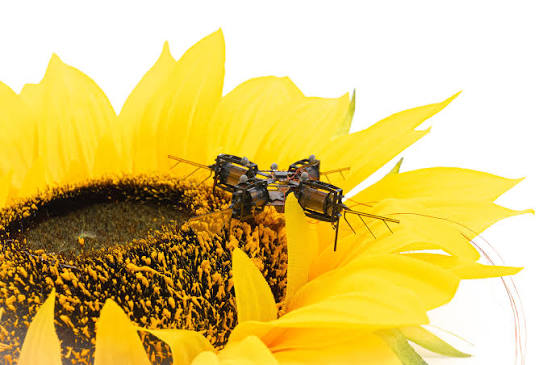
MIT researchers have built a tiny flying robot that carries its own sensors and computer. That may sound simple. However, most insect-sized robots can only fly inside a lab, where wall cameras tell them where they are. This robot is lighter than a paperclip, and it can sense its own position. As a result, it is a big step toward small robots that fly on their own over farms and fields.
Who is working on the flying robot?
Kevin Chen leads the work. He is an associate professor in MIT’s Department of Electrical Engineering and Computer Science, and he heads the Soft and Micro Robotics Laboratory. Jonathan How, the Ford Professor of Aeronautics and Astronautics, is also a lead author. In addition, Elizabeth Farrell Helbling of Cornell University worked on the project. Graduate students Yi-Hsuan (Nemo) Hsiao, Quang Phuc Kieu, and Zhongtao Guan co-led the paper. It was published in Science Robotics.
What is the flying robot project?
The robot is about the size of a microcassette. It is shaped like a plus sign, and it has four flapping wings. Soft artificial muscles power each wing. Earlier versions from the lab flew well. Still, they were too weak to lift any electronics. So the team designed a sensor and computer package that weighs only 244 milligrams. Then they rebuilt the robot so it could carry that package. If you enjoyed our story on MIT’s tiny robot bug, this is the next chapter.
How does the flying robot work?
First, the team needed more lift. They made the artificial muscles about 50 percent larger by tuning their length and radius. This raised the net lift by 46 percent. As a result, the robot now lifts almost twice its own weight.
Next, they added three sensors. One tracks how the robot tilts. Another measures how fast it moves sideways. A third measures its height. A light algorithm combines these readings very quickly. Interestingly, fast and frequent estimates worked better than slow and precise ones.
In tests, the robot hovered and flew between points with errors of only a few centimeters. For example, a pilot guided it around plants until it landed on a sunflower. Meanwhile, the electronics use only about 6 percent of the robot’s power.
MIT’s Impact
In the future, a flying robot like this could help pollinate almonds and blueberries where bees are declining. It could also check crops for pests or search tight spaces after a disaster. For now, the robot still needs a power cable. Therefore, the team plans to add batteries for outdoor flight and a camera to avoid obstacles. Drones are already changing field research, as Duke’s forest testbed shows. You can read more in MIT News.