
Introduction
As batteries are utilized in more fields and industries such as the exponentially booming electric vehicle market, more batteries than ever before are being destroyed, thrown away or broken down for other uses. The team at Northeastern University found that the small particles inside batteries which were previously believed to stay still actually moved around. They believe that these small particles can be tracked in models to build new types and designs of batteries that last much longer.
Who is working on the project?
The project has many contributors, engineers and scientists working towards this goal of longer lasting batteries and predicting degrading of batteries. However, the project is led by Juner Zhu, an assistant professor of mechanical and industrial engineering who conducts research on the project in the Kostas Research Institute. This group possesses many skills for various tasks and research including engineering, materials science and advanced computer physics models.
What is the project?
The project will significantly alter our understanding of the degradation of lithium ion batteries. This new understanding comes from the tiny particles that scientists believed remained still, actually moving around. The reason this observation is such a major development is the movement of the particles increases the rate of wear on batteries. By understanding and simulating these particle movements researchers and scientists can understand how to produce batteries in a way that reduces the movement of these particles to make batteries last much longer.
How does the project work?
In order to simulate these small particles the team is building a “Digital Twin” or microstructural electro chemo mechanical model which precisely maps and simulates the particle movements. It combines the physical measurements with physics and machine learning computer models to achieve this task. This works by training the models on the chemical, electrical and mechanical behavior of batteries which lets researchers test how different variables or things will affect the health and performance of batteries.
Drexel’s Impact
The impact of this Northeastern University research project has a major effect on electric vehicle manufacturers and the environmental sustainability of using many batteries. In the past testing batteries used destructive testing or waiting until the cells in batteries completely died out. With these digital twins, producers can test the performance of batteries before producing them. This will reduce the time of development, prevent premature battery failure, and will lead to more sustainable electric vehicle and battery development.
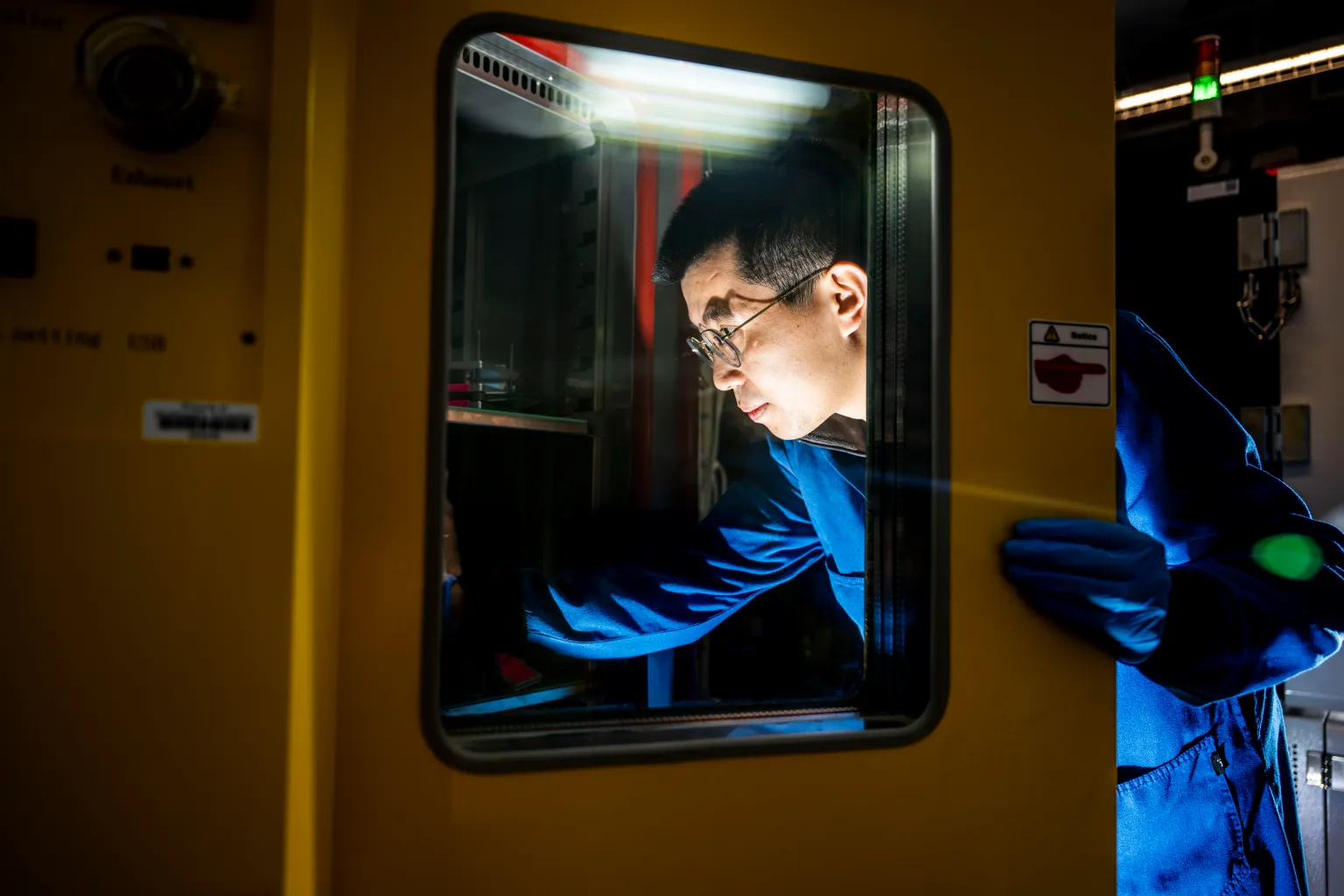
Image source: Juner Zhu, assistant professor, mechanical and industrial engineering, works inside The Kostas Research Institute. Photo by Matthew Modoono/Northeastern University
Sincerely,
Aarush Vajha