
Introduction
Researchers at MIT have developed a new method that enables robots to quickly generate accurate, large-scale 3D maps of their surroundings. This advancement has important implications for search-and-rescue missions, industrial automation, and extended-reality applications.
The Challenge: Mapping and Locating in Real-Time
One of the biggest hurdles in robot navigation is SLAM — Simultaneous Localization and Mapping. SLAM involves building a map of an environment while figuring out the robot’s position within it. Traditional methods often require calibrated sensors or expert setup, and learning-based models usually handle only a limited number of images, making them less effective in large or unpredictable spaces.
Imagine a robot navigating through a collapsed building — it needs to process thousands of images to map the area in real time while keeping track of its position.
The MIT Approach: Submaps and Stitching
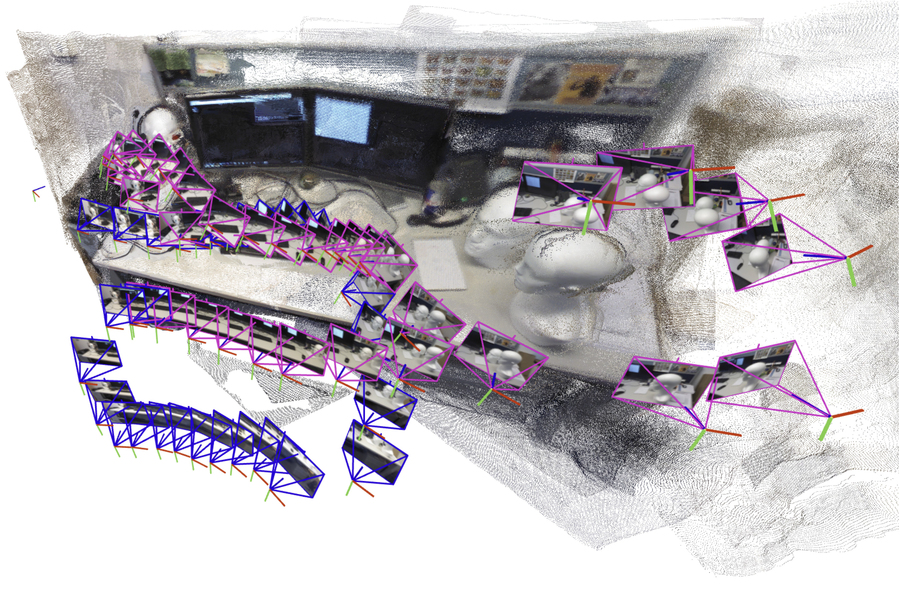
MIT’s solution divides the environment into smaller submaps, which the robot processes individually. These submaps are then stitched together to form a complete 3D reconstruction. The system uses mathematical transformations to adjust for inconsistencies in submaps, allowing accurate alignment and precise mapping.
Performance and Accuracy
The system works in near-real time, producing 3D reconstructions in seconds. It does not require calibrated cameras or complex hand-tuned systems. Even using short video clips from simple cameras, the system can map complex environments with an average reconstruction error of less than 5 centimeters.
Insights: Combining Old and New
By combining modern machine learning with classical geometric methods, the system takes advantage of both approaches. This hybrid strategy enables scalable and high-performance mapping in large and complex spaces.
Applications and Impact
The technology can be applied in many areas:
- Search-and-Rescue: Robots can navigate disaster sites, helping locate victims and mapping hazardous terrain.
- Warehousing: Industrial robots can efficiently move through large storage areas.
- Extended Reality: Wearable devices could build real-time 3D maps to improve spatial awareness and interaction.
Future Directions
Researchers aim to improve performance in cluttered or complex scenes and deploy the system on real robots operating in real-world environments.
Conclusion
This new mapping system represents a major leap in robotic perception, allowing machines to map and localize in large, complex environments with speed, accuracy, and simplicity. These innovations will be foundational as robots move into more dynamic and high-stakes domains.
Vraj Parikh