
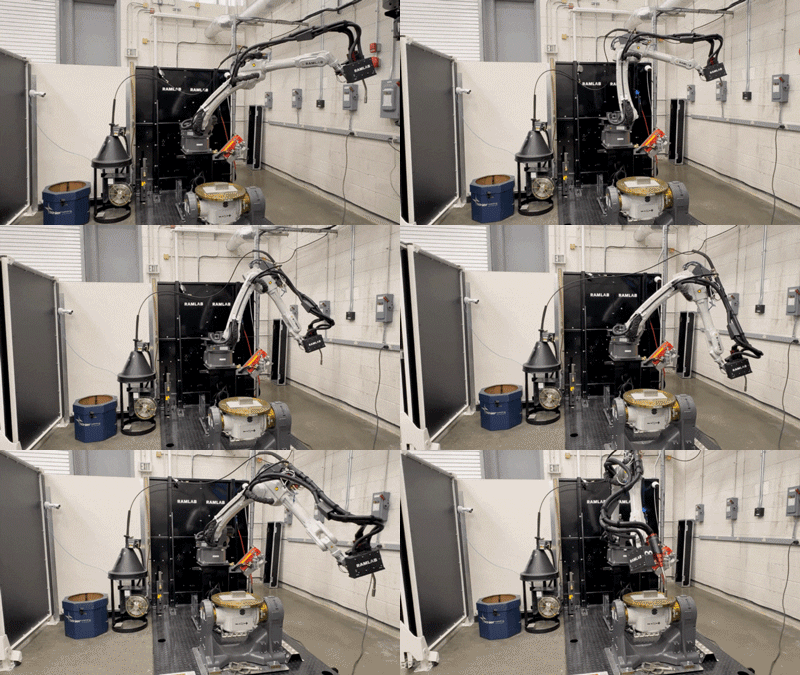
Johns Hopkins Applied Physics Laboratory (APL) has installed a high-capacity industrial robotic arm at its advanced manufacturing facility to push research in maritime repair and manufacturing. The move is aimed at strengthening the U.S. maritime industrial base by making advanced repair methods more practical and accessible to industry partners, including smaller businesses that normally can’t afford big manufacturing infrastructure.
The robot in question is the RAMLAB MaxQ, a six-foot-radius industrial arm designed for large-scale work. It uses wire arc additive manufacturing (WAAM), a welding-based process that feeds wire material to build or repair metal structures. Unlike traditional setups that need custom molds and expensive assembly lines, this system can operate in compact spaces and handle big components like hull structures or propellers without heavy fixturing.
What sets the system apart is its sensing and adaptive control capabilities. The arm can scan irregular or damaged parts, figure out where fixes are needed, and plan repair paths. Humans still guide the process, especially for precision work, but the combination of automation and expert oversight means repairs can be faster and more precise.
APL engineers are using the robot to refine methods that could reduce how often the Navy and other operators have to order replacement parts or take ships out of service for long periods. Making repairs in place, or at smaller partner facilities, could cut costs and downtime significantly.
This effort ties into broader work at APL on advanced manufacturing tech, including laser powder bed fusion and materials discovery, all aimed at making the U.S. defense and maritime industrial base more resilient.
Vraj Parikh